
A brass double compression gland is selected from the cable’s measured construction and the enclosure’s actual entry, not from nominal cable size alone. By the end, you will have a purchase checklist covering dimensions, compression parts, thread compatibility, accessories, standards and service conditions.
Key takeaways
- Record inner sheath, outer sheath and armour measurements at specified points.
- Select the gland from measured ranges, not nominal cable size.
- Check every included part, accessory and thread before issuing the order.
- Specify standards, materials and site conditions in the purchase document.
Record the cable construction and every measurement point
Nominal cable size is not enough for a brass double compression gland order. Send the cable construction and measurements taken at the manufacturer’s specified points; otherwise, the gland may seal the outer sheath while failing to grip the inner sheath.
Include these brass double compression gland order details:
- Conductor size and cable designation.
- Cable construction: steel wire armour, steel tape armour, wire braid, or another type.
- Inner bedding or inner-sheath diameter.
- Armour diameter, or armour thickness for tape-armoured cable.
- Armour-wire diameter, number of wires, or armour-tape width and thickness.
- Overall diameter over the outer sheath, including the manufacturer’s stated measurement method.
- Cable material, such as PVC, XLPE or elastomer, where it affects sealing.
The cable glands details before ordering brass double compression for types in mumbai should identify the dimensions that control each sealing and clamping point:
| Measurement | What to record | Why it matters |
|---|---|---|
| Inner bedding diameter | Actual minimum and maximum | Sets the inner seal range |
| Armour dimension | Wire diameter, or tape width and thickness | Selects the correct cone and clamp |
| Outer sheath diameter | Actual minimum and maximum | Sets the outer seal range |
| Cable construction | Armour type and cable drawing | Confirms gland compatibility |
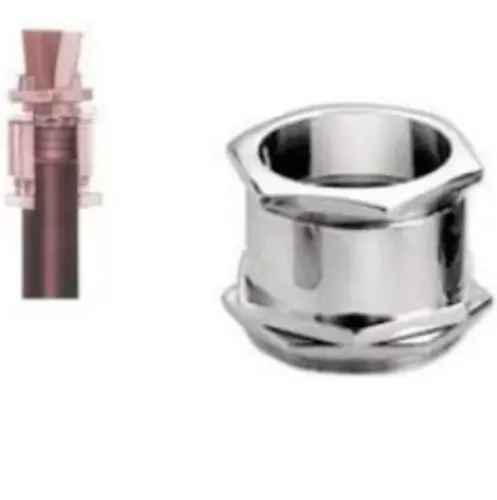
A double compression gland seals both the inner bedding and outer sheath, with armour-clamping parts between them. Ask for the manufacturer’s dimensional range and installation drawing; do not treat “double compression” or a nominal cable cross-section as proof of fit.
For hazardous areas, also provide the protection method, gas or dust group, equipment protection level and temperature class so the certificate covers the actual configuration.
Choose the gland from dimensional ranges, not cable size
A correct size is the one whose published ranges contain every required cable dimension, not the one labelled for the cable’s nominal cross-section. Measure and report the actual inner-sheath or bedding diameter, armour diameter or armour thickness, and outer-sheath diameter. A gland that seals the outer sheath can still fail to clamp the inner sheath.
| Measurement | Match it against | Why it matters |
|---|---|---|
| Inner-sheath or bedding diameter | Inner-seal range | Confirms the first compression seal grips the inner sheath |
| Armour diameter or thickness | Cone and armour-clamping range | Determines whether the armour is held securely |
| Outer-sheath diameter | Outer-seal range | Confirms the second compression seal closes around the cable |
| Armour construction | The specified gland type | Steel wire, steel tape and braid require different clamping arrangements |
Do not treat “double compression” as an IP rating. Request the manufacturer’s cable-diameter ranges, stated IP rating, test basis and installation conditions; the rating belongs to the tested gland-and-enclosure installation.
For cable gland specifications in Mumbai, state whether the entry is threaded, an unthreaded clearance hole, or an adaptor or reducer arrangement. Give the panel-hole diameter, enclosure-wall thickness and available internal clearance, because these dimensions can change the required gland length even when the cable measurements remain unchanged.
Include the manufacturer’s measurement points with your enquiry so the quoted size can be checked against the same locations.
Confirm the included parts and accessories line by line
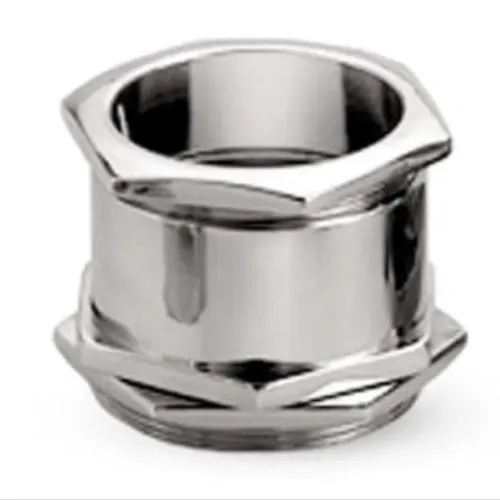
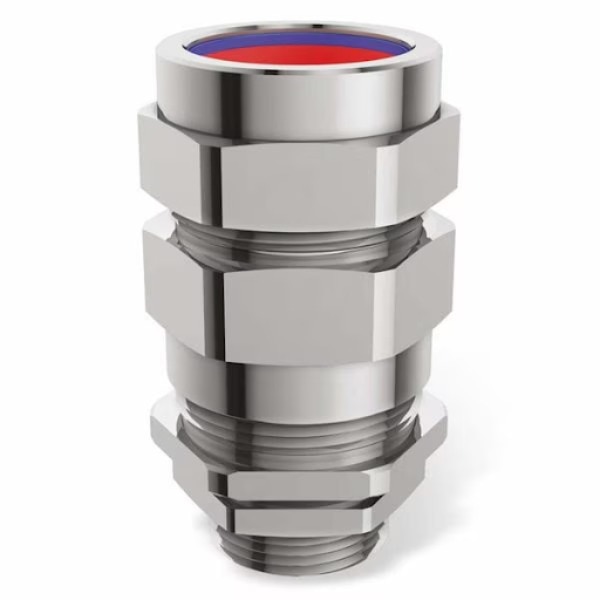
Your quotation should spell out the double compression gland included parts line by line, because “complete kit” does not guarantee every bonding or adaptation accessory. A standard assembly seals the inner sheath and outer sheath separately, with the armour-clamping components between them.
- Gland body
- Inner seal
- Outer seal
- Armour cone or armour-clamping ring
- Cone ring
- Locknut
- Protective shroud, if specified for the gland design
For brass double compression gland order details, confirm the cable’s measured inner-sheath diameter, armour diameter, armour-wire or armour-tape size, and overall diameter. A gland that seals the outer sheath can still fail to clamp or seal the inner sheath.
| Item | Standard kit status | Separate-order point |
|---|---|---|
| Earth tag | Not guaranteed | Order for equipment bonding |
| Banjo washer | Not guaranteed | Order when the earth tag needs a flat bonding base |
| Serrated washer | Not guaranteed | Order when the installation requires enclosure-to-gland bite |
| Bonding lead | Not guaranteed | Order when a flexible earth connection is specified |
| Reducer or adaptor | Not included | Order to change thread size or thread type |
| Locknut | Usually included | Confirm if the gland enters an unthreaded clearance hole |
| Protective shroud | Design-dependent | Confirm size, material and inclusion before ordering |
Ask the supplier to identify each part by quantity, material and thread compatibility. Do not assume an earth tag, reducer or bonding lead is included because the gland is described as double compression.
Match the gland thread to the enclosure entry
A gland thread that looks close to the enclosure entry can still jam, leak or damage the threads. Match the thread system and nominal size exactly; M20 × 1.5, NPT and ET are not interchangeable, and the locknut must use the same system.
| Entry arrangement | What to specify | When it applies |
|---|---|---|
| ET threaded entry | ET nominal size, effective thread length and matching ET locknut | The enclosure is tapped with an ET thread |
| NPT threaded entry | NPT size, thread specification and matching NPT locknut | The enclosure uses a tapered NPT entry |
| Metric threaded entry | Metric size and pitch, such as M20 × 1.5, plus effective thread length | The enclosure is tapped with a metric thread |
| Unthreaded clearance hole | Hole diameter, wall thickness, gland thread size and matching locknut | The gland passes through a plain panel hole |
| Adaptor or reducer arrangement | Both entry and gland threads, adaptor length and sealing method | The enclosure thread differs from the gland thread |
For an unthreaded hole, measure the actual panel-hole diameter rather than selecting by cable diameter. Wall thickness and available internal clearance can determine whether the gland body is long enough for the locknut and cable preparation.
State these measurements in cable gland specifications in Mumbai, especially when the enclosure drawing is unavailable. For cable glands details before ordering brass double compression for types in Mumbai, identify the entry as threaded, clearance-hole or adaptor-mounted before requesting a quotation.
The supplier can then confirm the gland length, locknut, washer and sealing arrangement instead of guessing from the cable size alone.
Put standards, materials and site conditions into the purchase specification
Your quotation must confirm the standard, construction, material, installation method and site environment—not merely the gland size. For brass double compression gland order details, repeat the cable’s actual overall diameter, inner-sheath diameter, armour diameter, and armour-wire or armour-tape dimensions. A gland that seals the outer sheath can still fail to clamp the inner sheath.
Ask the supplier to state:
- IEC 62444, or the project’s adopted national or legacy standard such as BS 6121, including edition and conformity documents
- Brass grade, plating or surface treatment, seal material, shroud requirement and corrosion protection
- Thread type and size, enclosure thickness, clearance-hole arrangement, tightening method and included accessories
- Manufacturer-stated IP rating, test basis, cable-diameter range and installation conditions; “double compression” alone is not an IP rating
- Indoor or outdoor location, Mumbai rain and humidity, ultraviolet exposure, temperature range, oil, chemicals, vibration and marine or coastal exposure
- For hazardous areas, protection method, gas or dust group, equipment protection level, temperature class, cable type and a certificate covering the exact thread, seals, gland configuration and accessories
| Site condition | Confirm in the quotation | What can change |
|---|---|---|
| Outdoor Mumbai installation | UV-resistant seals, plating and IP test conditions | Weathering or water ingress |
| Chemical or oil exposure | Compatible seal compound and coating | Swelling or loss of sealing |
| Hazardous area | Certificate for the complete installed configuration | Approval failure despite correct dimensions |
For cable gland specifications in Mumbai, Jay Enterprises can help reconcile the measured cable data with the stated environment; keep the approved standard and certificate requirements in the purchase order.
Related products
 | SINGLE COMPRESSION CABLE GLANDS We are one in all the leading makers, suppliers, and bourgeois of Single Compression Cable Glands to be used beneath most atmospheric condition. View product → |
 | CABLE GLANDS Double Compression Industrial Cable Gland Application - For use with all types of SWA cable for indoor and outdoor application. View product → |
Frequently asked questions
Which cable details must you record before ordering a brass double compression gland?
Record the cable construction and measurements at the manufacturer’s specified points, including the inner sheath, outer sheath, armour and overall diameter where requested.
Why is nominal cable size insufficient for gland selection?
Nominal cable size does not establish the diameters and armour dimensions needed for sealing and mechanical grip. Select the gland from its published dimensional ranges.
What should you check in a double compression gland’s included parts?
Confirm the gland body, compression components, seals, locknut, earth tag, shroud and any washers or accessories line by line against the supplier’s quotation.
How do you match a cable gland thread to an enclosure entry?
Compare the gland thread type and size with the enclosure entry, checking thread form, pitch, diameter, available thickness and sealing requirements.
What should a brass double compression gland purchase specification include?
State the cable construction, measured dimensions, gland size, thread, material, finish, sealing requirements, applicable standards and site conditions such as temperature, moisture and corrosion exposure.
Related products
 | CABLE GLANDS IP 68 Metric Threaded Single Compression Cable Gland We are India's leading manufacturer, supplier, and exporter of Metric Threaded Single Compression IP 68 Cable Gland, IP68 Universal Cable Gland. View product → |
 | CABLE GLANDS BRASS DOUBLE COMPRESSION GLANDS BRASS CABLE GLANDS DOUBLE COMPRESSION SIZE IN ET THREADS - 1/2 “ET - 4” ET SIZE IN NPT THREADS - 1/2 “ NPT - 4 ”NPT SIZE IN MM SERIES - M12 - M100 View product → |
 | BRASS / SS CHECKNUTS CHECKNUTS/LOCKNUTS FOR DOUBLE COMPRESSION GLANDS MATERIAL / BRASS / SS / ALLUMINIUM / MS SIZE - 1/2 ET - 4 ET SIZE - M12 - M100 ALL TYPES OF CHECKNUTS AND LOCKNUTS AVAILABLE View product → |